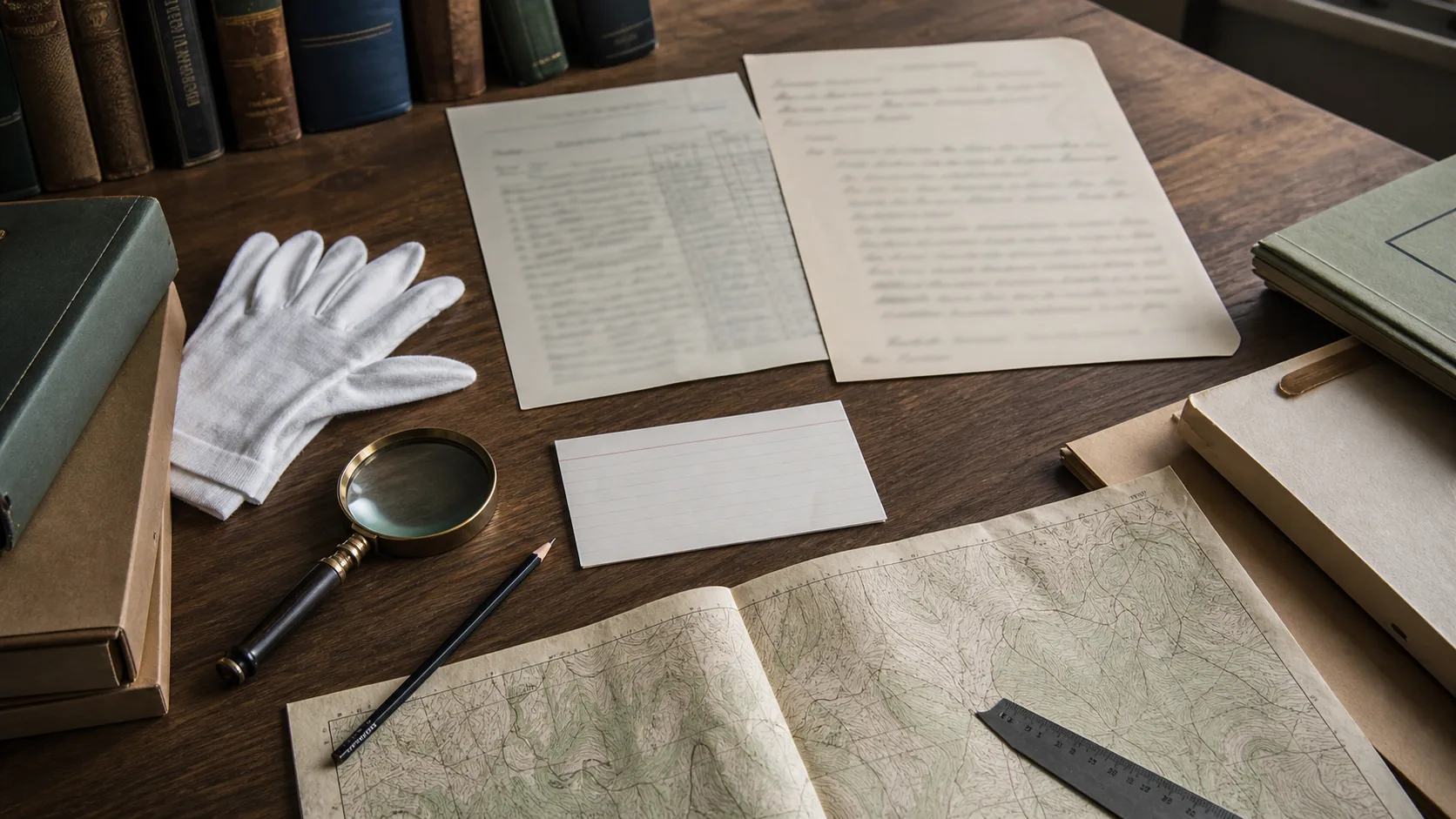
Burial research rarely arrives as one perfect record. A family note may give a nickname. A newspaper notice may state an intended cemetery. A death certificate may record a place of burial. A cemetery register may use a different spelling. A marker may display only years.
Corroboration is the practice of comparing these sources while respecting the purpose and limits of each. It does not mean counting three websites that copied the same original entry as three independent confirmations. It means tracing information back toward records created close to the event and explaining why the combined evidence supports a conclusion.
The Utah Division of Archives and Records Service recommends beginning with likely place and date information, then using sources such as death certificates, obituaries, and cemetery records. Its death-records guide also explains how access changes by period and notes that recent certificates remain private for 50 years.
What we know
Utah began statewide responsibility for death certificates in 1905, after an earlier period of county recording. The State Archives provides public indexes for eligible historical years and research guidance for earlier and later records. Before broad government registration, cemetery, newspaper, family, and church records may be especially important.
The Archives’ cemetery guide warns that many cemetery records are not indexed by personal name. This has a crucial implication: failure to find a name in a web search is weak negative evidence. The relevant volume may be undigitized, indexed under another spelling, or organized by location rather than name.
The Utah Historical Society’s cemetery resources are also described as ongoing collections. An expanding public database is a valuable finding aid, but “not yet present” and “not buried there” are different statements.
Build a source trail before a conclusion
Start with a research question narrow enough to test. “Where was this person buried?” is better than “tell me everything about this family.” Record the known statement and who supplied it. A family recollection is evidence of tradition even when it is not yet evidence of place.
For each source, capture:
- creator and repository;
- record type and original purpose;
- date the record was created;
- exact wording, including spelling;
- whether the image is original, a transcription, or a later index;
- stable identifier, page, certificate number, or URL;
- access date and any restriction notice.
Do not normalize the transcription. If an index differs from the image, preserve both and explain the difference in your notes.
Test whether sources are independent
An online memorial, a family-tree profile, and a cemetery index may all repeat one user-submitted entry. Their agreement looks impressive but may trace to a single unverified claim. Follow citations backward. If no source is named, the page is a lead, not corroboration.
Stronger combinations usually cross record systems. A state death certificate and a cemetery interment register were created by different offices for different duties. A contemporary newspaper notice can add context, while a burial permit or lot file may connect the event to a specific space.
Independence is not absolute. Funeral information may have been supplied to both the newspaper and registrar by the same relative. That is why the purpose and informant fields matter.
Resolve conflicts by explaining them
Suppose a certificate and marker disagree by one year. The wrong response is to silently choose the marker because it is visible. Ask when each was created and who provided the information. A certificate may contain an informant error; a marker may have been installed years later; an index may contain a transcription mistake.
Write a conclusion at the level the evidence supports: “The interment register and death certificate both identify the cemetery; the marker year differs and remains unresolved.” That sentence is more trustworthy than false precision.
Name variants deserve similar care. Search initials, nicknames, married and birth surnames, spacing, and phonetic spellings. Avoid merging records unless dates, relationships, and places also align.
Handle negative evidence honestly
A negative search must include its boundary. State the database, date range, spelling variants, filters, and access date. “No matching entry appeared in the public index searched on July 29, 2026” can be audited. “There is no burial record” usually cannot.
Absence becomes stronger only when the source is expected to be complete for that place and period and its organization has been understood. Even then, lost pages and clerical omissions remain possible.
Keep people at the center
Research notes can contain sensitive facts about health, parentage, residence, or living relatives. Publish only what serves the historical question. Do not expose recent private information, and do not contact grieving relatives with a demand that they resolve a discrepancy.
Corrections should be welcomed. Ask contributors for the source behind a proposed change, preserve the previous public wording in an internal log, and record why the revision was made. A respectful correction process turns uncertainty into better research instead of conflict.
What remains uncertain
We have not established a complete record series, current custodian, or official request procedure for Veyo Cemetery. Public mapping fields and third-party memorial entries cannot substitute for confirmation from the responsible record holder. We also cannot infer that every historical record survives or that every existing record is public.
Accordingly, no people-specific burial conclusion should be published here without a documented, reproducible source chain and a review for privacy and accuracy.
Sources
- Utah Division of Archives and Records Service, Cemetery and Burial Records guide: https://archives.utah.gov/research/guides/cemetery/
- Utah Division of Archives and Records Service, Death Records guide: https://archives.utah.gov/research/guides/death/
- Utah Division of Archives and Records Service, Utah Death Certificate Index: https://archives.utah.gov/research/index-death/
- Utah Historical Society, Utah Cemeteries & Burials overview: https://history.utah.gov/blog/utah-cemeteries-burials/